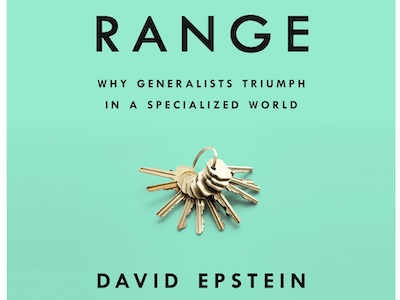
💡 Today’s Niblit: David Epstein’s “Range” reveals how our increasingly complex world favors generalists who can adapt and connect ideas across domains, rather than narrow specialists.
🔑 Key Insight: Our world is becoming more “wicked” – full of complex, ill-defined problems where feedback is often delayed or inaccurate. In these environments, generalists with broad knowledge often outperform specialists.
Imagine you’re lost in an unfamiliar city without a map. A specialist might excel at navigating one particular neighborhood, but a generalist with experience in various urban layouts could adapt more quickly to the overall challenge. Our modern world is full of such “wicked” problems – from climate change to economic policy – where the rules are unclear and the feedback is often ambiguous.
Specialists thrive in “kind” learning environments, where patterns repeat and feedback is immediate (think chess or golf). But in “wicked” domains, the ability to make connections across disparate fields, adapt to new information, and see the bigger picture becomes crucial. This is where generalists shine.
Why does this matter? As our world grows more interconnected and complex, the challenges we face increasingly resemble these “wicked” problems. Cultivating range in our skills and knowledge prepares us to tackle unforeseen challenges and innovate in unpredictable environments.
🦉 Nibble of Wisdom: In a world of wickedly complex problems, the fox who knows many things often outsmarts the hedgehog who knows one big thing.
🛠️ Practical Tip: Regularly expose yourself to ideas outside your main field of expertise. Read broadly, attend diverse lectures, or collaborate with people from different backgrounds.
🚀 Quick Action: Identify a current challenge in your work or personal life. Brainstorm how perspectives or tools from a completely different field might offer a novel solution.
🔍 Further Exploration:
Dive into the concept of wicked problems and how they differ from “tame” problems in problem-solving approaches.
Consider how analogical thinking can help in applying knowledge from one domain to another.
Explore the Dunning-Kruger effect and how it relates to overconfidence in specialists tackling problems outside their domain.
🎬 Wrapup: In our “wicked” world, adaptability is key. By cultivating range and embracing diverse knowledge, we equip ourselves to navigate uncertainty and find innovative solutions to complex problems.