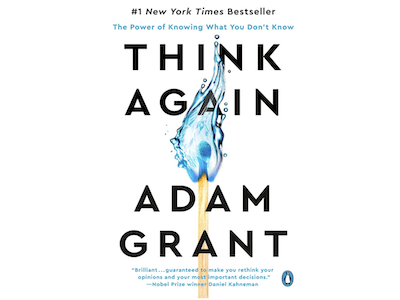
💡 Today’s Niblit: In Think Again, organizational psychologist Adam Grant reveals a sobering truth — the smarter you are, the more likely you are to fall into mental traps that prevent learning and growth. Through decades of research, he’s uncovered how even brilliant minds get locked into patterns that block their ability to rethink and grow.
🔑 Key Insight: When faced with challenges to our beliefs, Grant says most of us slip into one of three roles: preachers defending our ideals, prosecutors attacking the opposition, or politicians seeking approval. These mindsets feel productive but actually prevent us from growing and learning.
Consider how a scientist approaches the world — with curiosity rather than conviction, with hypotheses rather than certainty, and with experiments rather than arguments. This mental shift — from defending what we know to discovering what we don’t — improves how we process new information and solve complex problems.
Why does this matter? In a rapidly changing world, the ability to rethink and unlearn is becoming more valuable than raw intelligence. Those who stay mentally flexible will thrive, while those stuck in preacher-prosecutor-politician mode risk becoming increasingly rigid and outdated.
Personal Note from Tom:As a pastor for 20 years, I was well-trained to defend the absolute truths about God and morality that I still believe shouldn’t be compromised. But I found that most of my preconceived ideas about business, relationships, money, and politics are actually man-made rules. When I transitioned into the business world with this understanding, questioning everything became my superpower. Challenging the status quo made me a better thinker, made me a better writer, and made me a lot more money.
🦉 Nibble of Wisdom: “Knowledge is only part of intelligence. The larger part is the willingness to question what you know.” – Chapter 1
🛠️ Practical Tip: Next time you feel yourself getting defensive about a belief, pause and ask: “What would a scientist do here?” Then try to generate three questions about your assumption instead of defending it.
🚀 Quick Action: Pick one strongly held belief you have about your work or life (e.g., “I don’t have enough time to _____,” “Making a lot of money is ______,” or “I can’t say ______ or people won’t like me”). Take 3 minutes right now to write down three ways you could test whether that belief is actually true.
🔍 Further Exploration:
Consider how your most recent disagreement might have gone differently if you’d approached it as a scientist rather than a preacher or prosecutor
Reflect on which of the three limiting mindsets (preacher, prosecutor, or politician) you default to most often
🎬 Wrapup: Remember, the goal isn’t to abandon your convictions, but to hold them more loosely — to be confident enough to stay curious and humble enough to keep learning. Your beliefs should be more like hypotheses than commandments.